

7 Signs You Need Roof Replacement in Mumbai | Roofing Experts Guide
Introduction
A roof rarely fails all at once. In most buildings, the warning signs appear gradually: a small leak during heavy rain, stains on the ceiling, loose fasteners, visible rust, or a sheet that no longer sits firmly in place. Because these problems can seem minor at first, roof replacement is often postponed until the damage becomes difficult to ignore.
Mumbai makes roof performance particularly important. The city experiences intense monsoon rainfall, high humidity, strong sunlight for much of the year, and salty coastal air in many areas. These conditions can accelerate corrosion, moisture penetration, sealant deterioration and general ageing, especially when a roof has already spent many years exposed to the weather.
The right response is not to replace every ageing roof immediately. A professional assessment should first determine whether the existing system can be repaired safely and economically or whether replacement has become the more practical long-term option. Understanding the warning signs helps property owners make that decision before a roofing problem affects interiors, stored materials, electrical installations or day-to-day operations.
This guide explains seven important signs that may indicate the need for roof replacement in Mumbai, why they occur, and what property owners should consider before deciding on a new roofing system.
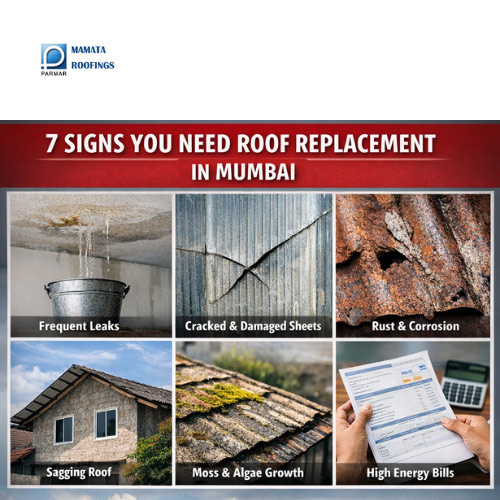
1. Repeated Roof Leaks Even After Repairs
One of the clearest signs of a roof nearing the end of its useful service life is recurring leakage. A single leak does not automatically mean the entire roof needs replacement. However, if water continues entering the building after repeated repair work, the underlying roofing system may have deteriorated beyond the point where isolated patching can provide a dependable solution.
In Mumbai, leakage often becomes noticeable during the monsoon. Water may appear as a ceiling stain, damp patch, dripping point, or moisture mark around a wall junction. The visible location is not always the actual entry point. Rainwater can travel beneath sheets, along overlaps or through damaged joints before reaching the interior.
Repeated leakage may be linked to deteriorated sealants, damaged overlaps, corroded fasteners, cracked roofing material, blocked drainage paths or ageing waterproofing layers. If several areas begin leaking at different times, the issue may be broader than one damaged section.
Frequent patching can also become inefficient. When one area is repaired and another begins leaking shortly afterwards, the property owner may spend repeatedly on short-term fixes without addressing the condition of the overall roof.
A roof assessment should therefore consider the age and condition of the entire system, not just the latest leakage point. If widespread deterioration is present, replacement may provide better long-term protection than continuing with isolated repairs.
2. Widespread Rust or Corrosion on Metal Roofing
Metal roofing can provide a long service life when the material, coating, installation and maintenance are appropriate. However, prolonged exposure to moisture and humid conditions can gradually cause corrosion. Mumbai's coastal environment can make this concern particularly relevant, especially for buildings located closer to the sea or in areas where airborne salts and persistent humidity affect exposed metal surfaces.
A small rust spot is not necessarily a reason to replace an entire roof. Surface corrosion can sometimes be treated when identified early. The concern increases when rust becomes widespread, deep or associated with visible thinning of the metal.
Look for reddish-brown corrosion around fasteners, sheet edges, overlaps, gutters and areas where water tends to remain. Bubbling coatings, flaking surfaces, holes and perforations are stronger indicators that the material may have suffered significant deterioration.
Corrosion can also weaken the points that secure roofing sheets to the supporting structure. Even when the main sheet looks reasonably intact from a distance, weakened fasteners or corroded fixing points can affect the roof's overall reliability.
If corrosion is widespread across multiple sheets, replacing selected components may not be sufficient. A professional inspection can determine whether the affected areas are repairable or whether a new roofing system would provide a more consistent and durable solution.
Property owners planning a replacement can also review different material and coating options based on the building's location, exposure, drainage requirements and intended use rather than selecting a product solely on initial price.
3. Cracked, Brittle, Warped or Damaged Roofing Sheets
Roofing sheets are exposed continuously to heat, rain, wind and changes in temperature. Over time, repeated environmental exposure can affect their physical condition. Depending on the roofing material, deterioration may appear as cracks, brittleness, warping, dents, holes, broken edges or deformed overlaps.
A few damaged sheets may be replaceable without disturbing the entire roof. The decision becomes more significant when damage is widespread or when the remaining sheets have become fragile.
Warping can interfere with proper water flow and may create points where rainwater collects. Cracks and holes can allow moisture to enter the building, while damaged edges may make overlaps less effective. In some systems, repeated expansion and contraction can also place stress on joints and fixing points.
The age of the material matters as well. A roof that has developed multiple types of damage over the years may have reached a stage where individual repairs no longer restore consistent performance.
Before replacement, the condition of the supporting structure should also be checked. A new roof should not simply cover an unresolved structural or drainage problem. The supporting members, slope, gutters, flashing and connection points all contribute to the performance of the finished roofing system.
For properties requiring controlled natural light, Polycarbonate Roofing Sheets may also be considered where appropriate. These sheets are used in applications such as covered walkways, industrial spaces, terraces and other areas where daylight transmission is useful. The suitability of a material depends on the building design, exposure and required performance, rather than appearance alone.
4. The Roof Has Become Structurally Weak or Unsafe
Some roofing problems are cosmetic, while others raise a more serious concern about structural safety. Sagging sections, visibly deflected sheets, weakened support members, loose components or areas that appear unstable should never be ignored.
A roof can become vulnerable when water has been entering for a long period and has affected supporting components. Corrosion may also reduce the strength of metal members and connections. In other cases, poor drainage can keep sections of the roof exposed to standing water for extended periods.
Visible sagging is especially important because it can indicate that water is collecting where it should be draining away, or that the roof assembly and its supports are no longer performing as intended. Walking on a visibly damaged roof can create additional risk and should be avoided unless a qualified professional has determined that access is safe.
For commercial, industrial and residential buildings alike, a structural assessment should form part of any major roof replacement decision. The objective is not simply to install new sheets but to ensure that the complete roofing assembly is suitable for continued use.
If a roof has deteriorated substantially, replacement may also provide an opportunity to improve drainage, strengthen weak areas, update fixing systems and address design limitations that contributed to repeated problems in the first place.
5. Water Ponding and Poor Drainage Keep Returning
A roof is expected to move rainwater away efficiently. When water repeatedly remains on the roof after rainfall, the issue deserves attention. Temporary water accumulation during exceptionally heavy rain can occur, but persistent ponding is different and may point to inadequate slope, blocked drainage, surface deformation or deterioration of the roof system.
Mumbai's heavy monsoon showers can place significant demand on gutters, downpipes and roof drainage routes. Leaves, dirt and debris can restrict outlets, while damaged or poorly positioned drainage components can prevent water from leaving the roof quickly.
Long-term ponding increases the amount of time roofing materials remain exposed to moisture. It can contribute to corrosion, sealant deterioration, staining, biological growth and leakage. In some roofing assemblies, repeated water accumulation may also add unnecessary load.
The first step is to determine why the water is not draining. Cleaning a blocked outlet may solve a maintenance issue. Correcting a slope or replacing damaged drainage components may address a design or installation problem. If the roof surface itself has become distorted or extensively deteriorated, however, replacement may be necessary.
When planning a new roof, drainage should be treated as a core design consideration rather than an afterthought. The roof profile, slope, gutters, outlets and downpipes should work together to handle expected rainfall conditions.
6. The Roof Requires Repairs Too Frequently
Repair history can reveal more about a roof's condition than one isolated defect. If the same property requires frequent work for leakage, fasteners, corrosion, damaged sheets, sealants or drainage problems, the total maintenance burden may indicate that the existing roof is approaching the end of its practical service life.
A repair is useful when it restores a specific defect and the surrounding roofing system remains sound. Problems arise when repairs become routine rather than occasional.
For example, repeatedly replacing damaged sections may make sense when the damage is limited. But if new defects keep appearing across different parts of the roof, the property owner should consider the broader condition of the system.
The financial calculation should include more than the cost of roofing material. Repeated labour charges, disruption to business operations, damage to stored goods, interior repairs and emergency work can all increase the real cost of maintaining an ageing roof.
This does not mean replacement is automatically cheaper. A professional assessment should compare the current condition, expected remaining service life, repair frequency and replacement requirements. For some buildings, targeted repairs may remain appropriate. For others, replacement can provide a more predictable maintenance plan.
Property owners can also reduce future problems by maintaining a documented roof inspection and maintenance schedule, particularly before and after the monsoon season.
7. The Roof Is Old and No Longer Meets Current Requirements
Age alone is not enough to declare a roof unsuitable. Roofing systems differ considerably in material, installation quality, exposure and maintenance history. However, age becomes an important factor when combined with repeated leakage, corrosion, damaged sheets, poor drainage or declining performance.
An older roof may also no longer match the building's present needs. A warehouse may have different ventilation and daylight requirements than it did when the roof was first installed. A residential extension may require a different roofing approach from the original structure. A commercial property may need improved weather protection, maintenance access or better drainage.
Replacement can therefore be an opportunity to reassess the complete roofing requirement rather than simply reproducing the old system.
Before selecting a material, consider the building's purpose, roof span, local weather exposure, desired lifespan, maintenance expectations, ventilation, daylight requirements and budget. The right roofing solution should be selected according to these practical factors.
For property owners researching materials, manufacturers and roofing options in the state, it is useful to compare specifications carefully rather than choosing solely on thickness or price. Roofing Sheet Manufacturers in Maharashtra can be reviewed as part of that research when assessing available roofing products and applications.
Repair or Replacement: How Should You Decide?
The most practical approach is to compare the extent of damage with the condition of the remaining roof.
Repair may be appropriate when:
- Damage is limited to a small, clearly identifiable area.
- The main roofing material remains strong and stable.
- Corrosion is superficial rather than widespread.
- Fixing points and supporting structures are in good condition.
- Drainage works properly after maintenance or minor correction.
- Leakage has a specific and repairable cause.
Replacement becomes more relevant when:
- Leaks are widespread or repeatedly return.
- Corrosion affects multiple sheets or structural connections.
- Roofing sheets are cracked, brittle, warped or extensively damaged.
- The supporting system has deteriorated.
- Drainage problems are caused by the condition or design of the roof itself.
- Repair work is becoming frequent and costly.
- The roof no longer suits the building's present requirements.
The decision should be based on inspection rather than appearance alone. A roof can look acceptable from ground level while having significant deterioration at overlaps, fasteners, concealed areas or support connections.
For technical guidance, property owners can also review Roofing Guides for Maharashtra to better understand roofing materials, applications and maintenance considerations before discussing a project with a professional.
What to Check Before Starting Roof Replacement in Mumbai
Roof replacement is a significant building project, so planning is important. Before work begins, consider the following points.
- Inspect the existing roof
- Identify leakage patterns, corrosion, damaged sheets, drainage issues and areas of structural concern. Photographs and maintenance records can help during evaluation.
- Check the supporting structure
- A new roof should be installed over a structure that is suitable for the proposed system. Damaged supports, purlins or connection points may need attention first.
- Review drainage
- Confirm that gutters, outlets and downpipes can manage the expected rainfall. A new roof will not solve a drainage problem if the water management system remains inadequate.
- Select material according to application
- Consider metal roofing, coated sheets, polycarbonate solutions or other appropriate systems based on the building's use and exposure. Material selection should be driven by performance requirements.
- Consider Mumbai's weather
- High humidity, monsoon rainfall, heat and coastal exposure can influence material choice and maintenance requirements. Fixings, coatings, sealants and detailing should be appropriate for the environment.
- Plan the work safely
- Roofing work involves working at height and handling large materials. The project should include appropriate access arrangements, safety measures and protection for people and property below.
- Understand maintenance requirements
- Every roof requires some level of inspection and upkeep. Ask about cleaning, fastener checks, drainage maintenance and periodic inspection so the new system can be maintained properly.
- Get a clear scope of work
- Before approving a project, confirm what is included: removal of old material, structural corrections if required, new sheets, flashings, fasteners, drainage components, disposal and finishing work. A clear scope reduces misunderstandings during installation.
How to Extend the Life of a Roof
Roof replacement can often be delayed when the existing system is inspected and maintained properly. Good maintenance does not make a roof permanent, but it can help identify small defects before they become expensive problems.
Schedule inspections before the monsoon and again after periods of severe weather. Check drainage outlets, gutters, overlaps, fasteners, flashings and visible roofing surfaces. Remove accumulated leaves and debris so rainwater can move freely.
Do not ignore minor leaks. A small water mark may indicate a problem that becomes much larger during repeated rainfall. Similarly, early signs of rust should be assessed rather than simply covered with paint without identifying the underlying cause.
Avoid unnecessary drilling, cutting or attaching equipment directly to roofing sheets without proper detailing. Any penetration can create a potential path for water if it is not sealed and finished correctly.
For industrial or commercial properties, maintain a simple record of inspections and repairs. Tracking where and how often problems occur can help identify when a roof is becoming increasingly unreliable.
Most importantly, do not use the roof as a storage area unless it has been specifically designed for that purpose. Unplanned loading, movement of equipment and careless maintenance work can damage roofing materials and protective coatings.
When Should You Seek a Professional Roofing Assessment?
A professional assessment is sensible when the problem is repeated, widespread or difficult to identify. It is particularly important when you notice structural movement, extensive corrosion, significant sagging, multiple leakage points or damage following severe weather.
Do not rely only on an interior ceiling inspection. Water can travel through a roofing assembly before appearing inside, so the visible stain may not identify the true source.
Similarly, avoid making a replacement decision based solely on the age of the roof. Two roofs of the same age can be in very different condition because of differences in material, exposure, installation and maintenance.
A qualified roofing professional can assess the roof as a complete system and help distinguish between a repairable defect and broader deterioration. If you need to discuss the condition of an existing roof or possible replacement requirements, you can contact Roofing Specialists in Maharashtra for a professional discussion.
Conclusion
A roof gives plenty of warning before it reaches a critical stage, but those warnings are easy to overlook when the problem appears small. Recurring leaks, widespread corrosion, damaged sheets, structural weakness, persistent ponding, frequent repair requirements and advanced age can all indicate that the existing roofing system deserves a detailed assessment.
For Mumbai properties, monsoon rainfall and humid conditions make proactive roof maintenance especially valuable. The objective should not be to replace a roof unnecessarily, but to understand its actual condition and choose the most suitable solution for the building.
If repairs can safely restore the roof, they may remain the right choice. If deterioration is widespread and the roof no longer provides dependable protection, replacement may be the more practical long-term approach.
Regular inspection, effective drainage, suitable materials and timely maintenance can help property owners protect their buildings and avoid turning a manageable roofing issue into a major repair project.
FAQs
Q1. How do I know if my roof needs replacement or repair?
A1: A roof may need replacement when damage is widespread, leaks repeatedly return, corrosion is extensive, structural components are weakened, or repairs are becoming frequent. If the problem is limited and the surrounding roof remains in good condition, repair may be possible. A professional inspection is the safest way to distinguish between the two.
Q2. How long does a roof usually last in Mumbai?
A2: There is no single lifespan for every roof. Service life depends on the roofing material, coating, installation quality, exposure, drainage and maintenance. Mumbai's humidity, monsoon rainfall and coastal conditions can influence deterioration. Regular inspections can help determine whether an existing roof remains suitable.
Q3. Is roof replacement necessary if there are only a few leaks?
A3: Not necessarily. A few leaks can sometimes be repaired if the underlying roof is otherwise sound. However, if leaks keep returning in different locations or are accompanied by corrosion, damaged sheets or poor drainage, the issue may indicate broader deterioration. An assessment can help determine whether repair or replacement is more appropriate.